The answer to the ultimate question of life, the universe, and everything? New NICE HTA manuals
By Xcenda
The National Institute for Health and Care Excellence (NICE) recently published two new health technology assessment (HTA) manuals detailing updates and changes in the way it carries out the evaluation of health technologies. What does this mean for patients, the National Health Service (NHS), life science companies, and NICE itself?
Since 1999, NICE has been producing healthcare guidance to support the NHS in Englanda in choosing treatments that provide value for money. NICE was set up to enhance consistency and fair access to health technologies regardless of the disease area. However, as healthcare has evolved with increasingly complex treatments available, the systems used to evaluate these technologies also needed updating. Thus in 2019, in its 20th anniversary year, NICE embarked on the process of updating its ways of working. The review included numerous steps involving many different stakeholders and led to the publication, on 31 January 2022, of two updated NICE manuals, one for topic selection and the second for processes and methods, with implementation the following day, for all new evaluations.
NICE has updated its systems in 3 ways:
- How topics are chosen for evaluation (topic selection)
- The steps included within the evaluation (process)
- How evidence may be collected and considered (methods)
Not only do these changes improve the system for evaluating healthcare products, but they also support the UK government’s life science vision and the NHS Long Term Plan, by driving healthcare innovation and providing quicker patient access to it. This marks a significant deliverable in the implementation of NICE’s 5-year strategy, which is committed to producing rapid, robust, and responsive recommendations for the NHS.
So, what changes has NICE made?
One of the main updates has involved aligning all the guidance development processes, where possible. Until this change, each guidance-producing programme (highly specialised technologies, technology appraisals [TA], medical technologies evaluation, and diagnostic assessment [DA]) had its own topic selection steps, processes, and methods guide that all differed, potentially causing inconsistency and confusion (Table 1). However, there are still some differences between the processes:
- The deadline for company submission, and companies not having to provide a submission for a DA
- The period to submit comments during technical engagement
- Managed access and commercial agreements are only an option for medicines being appraised
- Cost comparison replaces the TA fast-track appraisal
However, their overall alignment should ensure a more uniform process, thereby:
- Speeding up patient access to innovative treatments
- Producing guidance that the NHS can implement more quickly
- Providing greater clarity to life science companies about what is expected of them
Table 1. A summary of the main changes NICE has implemented, and programmes affected
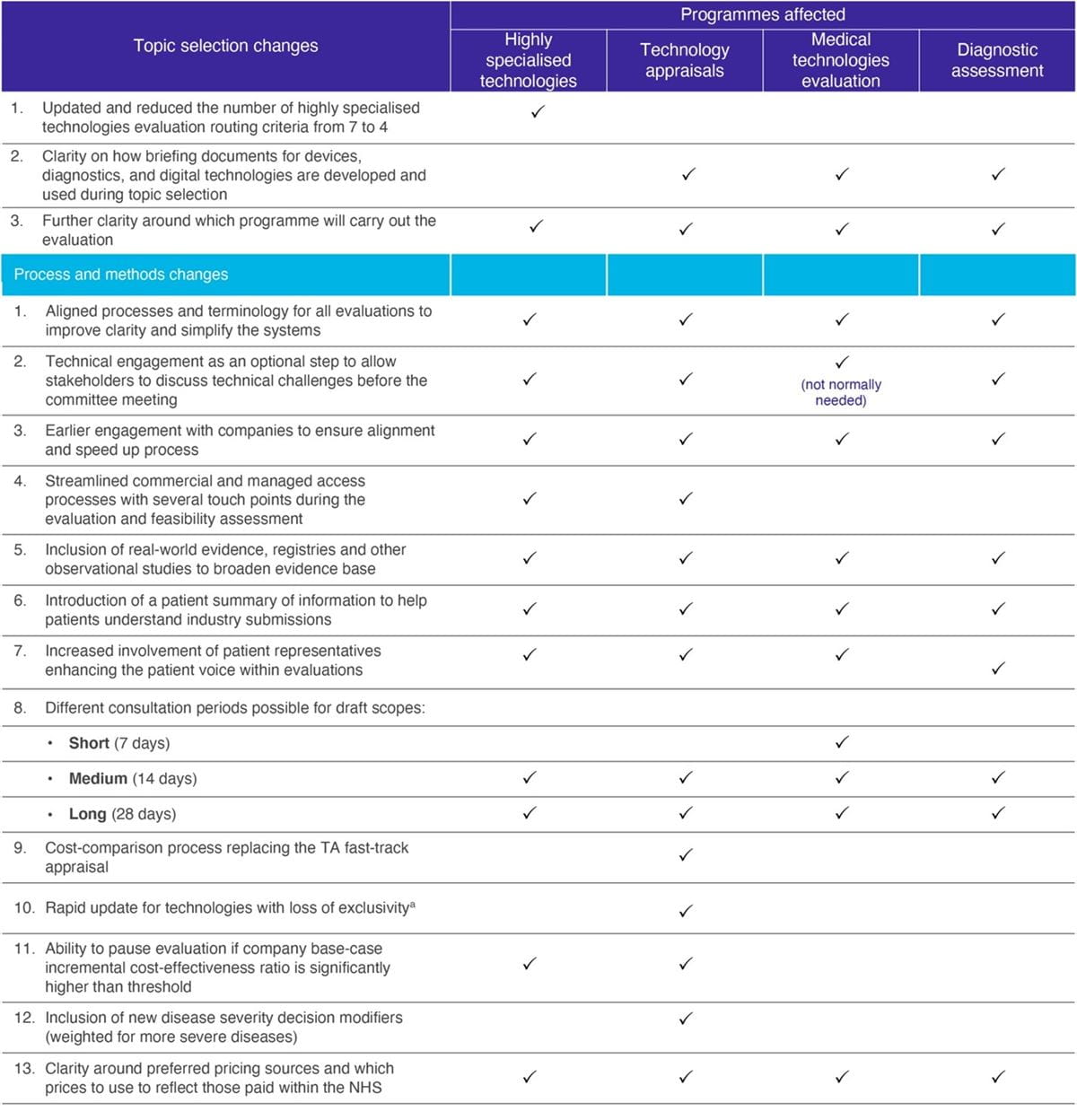 NHS – National Health Service; TA – technology appraisals.
a If technology was recommended in an optimised population, only in research or not recommended. Update focuses on active substance, not individual products.
How will these changes benefit the system?
The above changes improve consistency, clarity, and transparency for all stakeholders involved including NICE committees. They also allow greater flexibility within the wider system, aligning with initiatives like the innovative licensing and access pathway (ILAP), driving earlier evaluation and patient access. The change from the end-of-life modifier to a severity modifier means that a broader range of severe diseases are potentially included, not just those with a short life expectancy, suggesting a higher willingness-to-pay for innovative treatments for severe diseases. This will give hope to a larger number of patients and clinicians, who may have been unable to access treatments evaluated under the old NICE systems, and reflects feedback from the public who regard some diseases outside cancer as equally important. It should support innovative development of treatments and potentially allow companies to be rewarded appropriately. The system will also incorporate more patient and carer views, along with real-world evidence, providing additional real-life experience in the evaluation process, giving stakeholders a stronger voice, and providing a platform that can consider a broader range of evidence. The updated manuals similarly support companies in understanding what’s required both when involved in the process of evaluation and within company submissions.
Which areas require further consideration?
Accelerated patient access to the right treatment is the goal. Inherent in earlier assessment of technologies is the incorporation of greater uncertainties, increasing the probability of making less robust choices. It will be interesting to determine over time whether treatments that would have received positive recommendations under end-of-life or “original” highly specialised technologies' selection criteria will still have a positive experience within the new system. NICE may also find ensuring consistent presentation, consideration and acceptance of both real-world registry or trial data and anecdotal data a challenge (although the NICE real-world evidence framework should help). This same consistency issue also needs to be considered for the severity of the disease, where the committee will contemplate these on a case-by-case basis. NICE will need to be clear about how consistency will be maintained across all evaluations.
To continue surfing this positive wave of review, NICE also needs to propose time frames for future modular updates, including implementation of evidence-based, disease-severity modifiers, how to value considerations such as health-related quality of life for children and wellbeing of carers and updates to the discounting rate to ensure the system can prepare for further changes.
Final thoughts
NICE’s ambition to develop a flexible but fair process allowing patients access to the most innovative treatments while making the NHS attractive to life science companies and keeping the NHS affordable is of the utmost importance. The new manuals provide positive steps forward to enhance this ambition, with a more flexible and pragmatic system, although ensuring these requirements are reflected consistently across evaluations may still be a challenge. Only time will allow reflection on the implemented changes, and learnings acquired over the coming months will be important to see if the new systems have brought about the required improvements. With the UK a reference country for many global markets and health technology decisions, the world is watching.
* Service-level agreements are in place to help disseminate NICE technology evaluation guidance in the devolved administrations in Wales and Northern Ireland.
The article should be referenced as follows:
Hall C, Tolley K, Poole C. The answer to the ultimate question of life, the universe, and everything? New NICE HTA manuals. HTA Quarterly. Summer 2022. https://www.xcenda.com/insights/htaq-summer-2022-nice-hta-manuals
Sources
- Baig F. The UK Innovative Licensing and Access Pathway—A new paradigm in market access. HTA Quarterly. Spring 2022. https://www.xcenda.com/insights/htaq-spring-2022-uk-innovative-licensing-and-access-pathway/
- HM Government. Life Sciences Vision. Build Back Better: our plan for growth, July 2021.
- National Institute for Health and Care Excellence. Health technology evaluations: the manual. Appendix 1, Real World Evidence Framework. January 31, 2022.
- National Institute for Health and Care Excellence. Health technology evaluations: the manual, January 31, 2022.
- National Institute for Health and Care Excellence. Health technology evaluation topic selection: the manual, January 31, 2022.
- National Institute for Health and Care Excellence. The NICE strategy 2021 to 2026, April 2021.
- Poole C, Tolley K. Is NICE becoming nicer? HTA Quarterly. Winter 2021. https://www.xcenda.com/insights/htaq-winter-2021-nice-becoming-nicer/
- The NHS Long Term Plan, January 2019.