
Fifty shades of… innovativeness: The Italian job
By Xcenda

The introduction of any innovation has never been easy. In the XVI century, Niccolò Machiavelli highlighted in The Prince “the incredulity of men, who do not readily believe in new things until they have had a long experience of them.” Focusing on the biopharmaceutical market, let’s start from a critical point: each biopharma company is (usually) convinced that its new product provides an incremental innovation. The point is how healthcare systems, policymakers, and decision makers assess and recognize innovation, besides what are or what should be the implications for any innovative product.
In Italy, the recognition of therapeutic innovation for a medicinal product was first introduced by the Italian Medicines Agency (AIFA) in 2007 through the approval of the Montanaro algorithm, which recognized the degree of therapeutic innovation (important, moderate, low) by considering various scores related to pre-existing treatments and therapeutic effect in a precise, rationalized way, where also the technological advance was taken into account. Despite being formally issued, this methodology never took off and did not have any impact on the pricing and reimbursement (P&R) process.
Meanwhile, other European healthcare systems started implementing and/or reforming P&R processes often focusing on the assessment of the added value of a drug in a certain indication (e.g. France with the amélioration du service médical rendu [improvement of the medical service provided] and Germany with the Zusatznutzen [additional benefit]).
Discussion on how to improve and formalize the Italian process and recognition of a drug’s innovation started in the 2010s and continued till Budget Law 2017 required AIFA to issue clear rules. Finally, AIFA decree 1535/2017 stated the rules for the process to be followed for assessment of innovative status, determined separately from and in parallel with the P&R process, detailing the 3 criteria the Technical Scientific Committee (CTS) might consider to assess the degree of innovation of a drug in a specific indication:
- therapeutic need (based on the value of the alternatives),
- added therapeutic value, and
- quality of evidence provided.
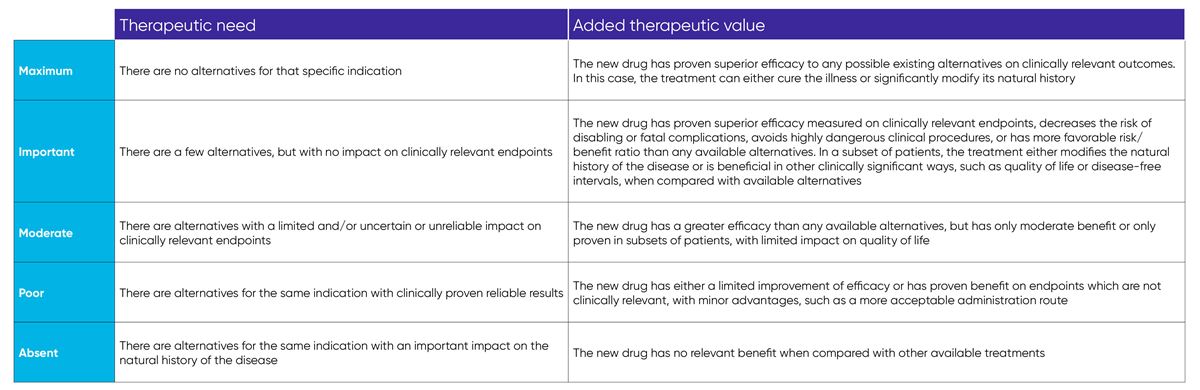
Unmet need and added therapeutic value are ranked from ABSENT to MAXIMUM (Table 1). Unlike other countries where quality of evidence is embedded into the therapeutic value judgment, in Italy it is evaluated separately, following the standard rules of the GRADE (Grading of Recommendations, Assessment, Development and Evaluation) method with 4 possible categories from VERY LOW to HIGH.
Table 1. Definition of the 5 possible scores for therapeutic need and added therapeutic value by AIFA decree 1535/2017
AIFA – Italian Medicines Agency.
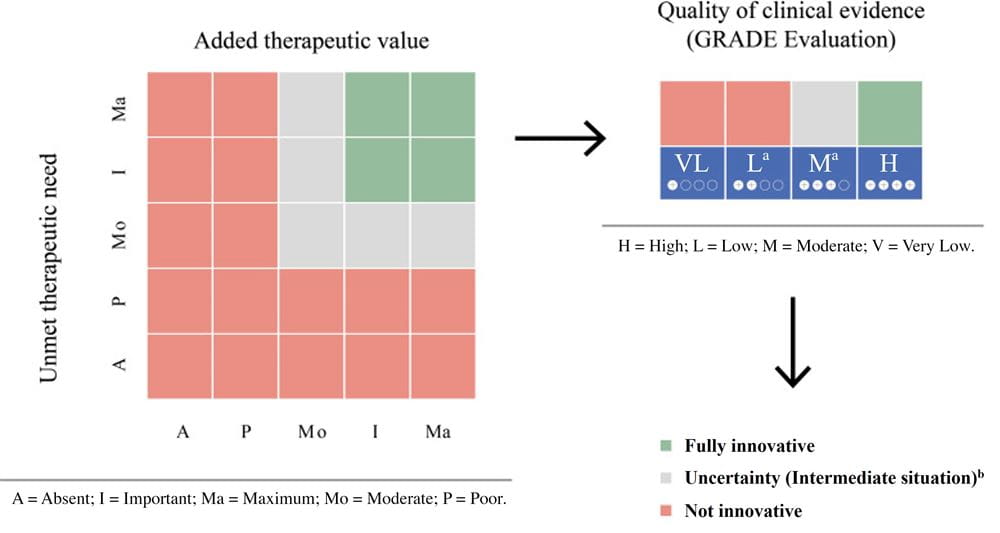
By law, CTS can award a full innovativeness status when criteria 1 and 2 are at least scored important and the quality of evidence is high (see green shading in Figure 1 below). For drugs indicated for rare diseases (according to European regulation) the GRADE assessment may also be low, given the acknowledged difficulties of running high-quality randomized controlled trials for these conditions. In these cases of full innovativeness status, economic and time-to-market benefits are recognized for a 3-year period:
- Expenditure is covered by a dedicated fund,
- Mandatory reductions on the price required by law (ie, -5%–5% reductions) do not apply, and
- Immediate access to the regional formularies provides a time-to-market advantage.
CTS can alternatively award a potential innovativeness status for products with lower rankings (generally moderate level) where immediate access to regional markets is the only benefit. AIFA decree 1535/2017 also mentions that “intermediate situations are evaluated on a case-by-case basis,” thus allowing CTS to be less stringent on innovativeness outcomes in cases of uncertainty.
Figure 1. Criteria used to evaluate innovativeness adopted by the AIFA (adapted from Di Marzio 2017)
AIFA – Italian Medicines Agency; GRADE – Grading of Recommendations Assessment, Development and Evaluation.
a For rare diseases, fully innovative status is attributed in the presence of at least important unmet therapeutic need and added therapeutic value, and at least low quality of clinical evidence.
b The innovativeness appraisal must be decided on a case-by-case basis.
The outcome of the innovativeness evaluation is made public following publication of the P&R decision in the Official Journal.
Up to December 2022, CTS has assessed the innovation status of 189 products using the 2017 criteria. Of these, 63 (33%) were recognized as fully innovative by AIFA and 51 (27%) were assessed as potentially innovative. For those without innovative status, 69 (37% of those assessed) were reimbursed, as reimbursement is not linked to innovation, and 6 (3%) were not reimbursed. Of those evaluated, 87 (46%) were orphan and 117 (62%) were antineoplastic and immunomodulating agents (ATC code: L). Additionally, since the introduction in 2022 of a “not evaluable” outcome for the added therapeutic value criterion, this has been applied to 14 assessments where the value of the drug in the specific indication is deeply uncertain and further evidence is needed for any judgment on innovation (while the P&R process proceeds independently). Changes such as the introduction of the “not evaluable” score demonstrate the evolution in the approach since introduction of the 2017 innovativeness criteria.
As of December 2022, the 3-year period of benefits applied to innovative products had expired for 38 (20%) medicinal products/indications, which retain their reimbursement status but no longer benefit from the additional advantages applied to innovative products.
Recent assessments agree that added therapeutic value compared with available alternative treatments is the key driver of the innovativeness status, measured on clinically relevant endpoints (e.g. overall survival is the gold standard for oncology drugs, and other endpoints such as progression-free survival or disease-free survival may be considered). Moreover, if the added therapeutic value obtains a lower score (e.g. moderate), then the quality of the evidence gains a determinant role in the decision.
Interestingly, technological innovation is not part of the innovative status assessment, as demonstrated by the contrasting cases of 2 orphan drugs, Vyxeos for the treatment of acute myeloid leukemia, and Zalmoxis for high-risk haematological malignancies. Vyxeos was awarded full innovation status with moderate therapeutic need, important added value, and moderate quality of evidence, even though the combination components (cytarabine and daunorubicin) were old, while Zalmoxis was deemed not innovative with moderate therapeutic need, moderate added value, and very low quality of evidence despite the application of an advanced technology (genetically modified allogeneic T lymphocytes).
These examples also highlight that assessment of innovation is not black and white, and the outcome often does not align with the rules. When analyzing the scores per single criteria after CTS assessment, we found that the case-by-case approach was applied to 51 out of 63 (81%) assessments of drugs deemed to be fully innovative, since at least one score was lower than the minimum required for fully innovative status as stated by the rules of the decree.
In a poster presented at ISPOR Europe 2019, despite a limited experience by AIFA and a restricted number of available assessments on innovative status at the time of the analysis, we came to the same conclusion: there is no real stringent matching between AIFA criteria (as reported by AIFA decree) and the granting of full innovative status. In fact, many cases are borderline situations and were assessed case-by-case, leaving a shade of subjectivity that gives the innovativeness decision-making process a margin of flexibility. Biopharma companies hoping to launch products in Italy should be aware of the rules, while also accepting that there are gray areas where CTS has the flexibility to evaluate products on a case-by-case basis. Companies that can clearly communicate the unmet need and added value of their products, supported by high-quality evidence, are most likely to achieve the desired outcome.
While this article considers the current methods for assessing innovation in Italy, recent approval of Budget Law 2023 indicates that changes may be on the horizon. In addition to changes in AIFA governance, the 2 committees currently involved in the P&R process (CTS and CPR) will be merged in the near future (probably from July 2023) into a single Scientific and Economic Commission composed of 10 members who will deal both with the scientific aspects and the price negotiation. This is very similar to the pre-AIFA situation up to 2001: will it be a step back to the past? What are the implications for the P&R process and for innovative status recognition? Watch this space!
Sources
- Casilli G, Ronco V, Lidonnici D, Lanati EP. Fifty shades of... Innovativeness in Italy. Poster PMU44, ISPOR Europe 2019, Copenhagen, Denmark. Value Health. 2019;22(S3):S715-S716.
- Di Marzio S. E l’AIFA tracciò la strada dell’innovatività. AboutPharma. 2017;148:28-30.
- Fortinguerra F, Tafuri G, Trotta F, Addis A. Using GRADE methodology to assess innovation of new medicinal products in Italy. Br J Clin Pharmacol. 2020;86(1):93-105.
- Fortinguerra F, Perna S, Marini R, Dell'Utri A, Trapanese M, Trotta F.; Scientific & Technical Committee (Commissione Tecnico-Scientifica, CTS) of Italian Medicines Agency-AIFA. The assessment of the innovativeness of a new medicine in Italy. Front Med (Lausanne). 2021;8:793640.
- Galeone C, Bruzzi P, Jommi C. Key drivers of innovativeness appraisal for medicines: the Italian experience after the adoption of the new ranking system. BMJ Open. 2021;11(1):e041259.
- https://www.aifa.gov.it/documents/20142/516919/Determina_criteri_classificazione_farmaci_innovativi.pdf
- https://www.aifa.gov.it/farmaci-innovativi
- http://www.agenziafarmaco.gov.it/allegati/documento_integrale.pdf
- Machiavelli N. The Prince. Penguin Books; 1981.


